Me – An international student in the UK exploring the world.
Hello! My name’s Careyann. I’m an international student originating from the tropics of Malaysia. This blog surrounds the events that occur almoston a daily basis in my life. Follow me as I journey through my final year of university. Here, you can find my highs and lows of my university experiences. I also document the life of my fellow students to showcase the problems that university students face, here in the UK. I believe that the data I collect based on my ongoing research on this topic can aid in the betterment of universities in the UK. I mean, someone needs to point out these issues at some point, right?
Give me a follow and be entertained with my daily endeavors! I will also be posting up some great tips for university students on various topics. So, watch this space for these updates!
All in all, i believe that our days at uni has got to be lived to the fullest. And these issues should not hinder us from doing that!
In the end, it’s not the years in your life that count. It’s the life in your years. – Abraham Lincoln
How do students travel all the countries if they are on a tight budget?
What are the tips to help students save money for their next trip?
Where is the best places to travel with a budget?
5 tips to help you save for your next holiday
Video Source: Vimeo – SOTC Holidays
Are you planning to travel on a budget? Here are several tips to help you save money and time when you plan a vacation.
Firstly, you should plan ahead for every trip you are going. You should plan your budget accordingly, like in booking for flights and accommodation beforehand drastically reduces expenses.
Secondly, you should open a vacation account. Opening a savings account that is only meant for the vacation will help you to keep track of how much you save. Also, get a Monzo card. It is very useful and convenient, especially for travelling around the world.
Thirdly, you should travel off season. By travelling in this period of time, you would be able to save money and also time, because you will not have to be in long queues since there would not be a large crowd.
Fourthly, you should fly when its the cheapest. One of the way is to use tools like google flights to check for affordable flight prices and plan your trip accordingly.
Lastly, you should go to off-beat places. Some of these places that are affordable Cambodia, Laos, Bhutan and Bali offer similar experiences compared to many popular destinations but at a cheaper price.
The video above is produced by SOTC Holidays, which talked about essential tips that will help you to save money for your next holiday. Check it out!
Are tuition fees too high and could they be a lot lower without a fall in the quality of education?
Are universities making too much money out of accommodation?
Is campus food too expensive and unhealthy? Are there better alternatives for students?
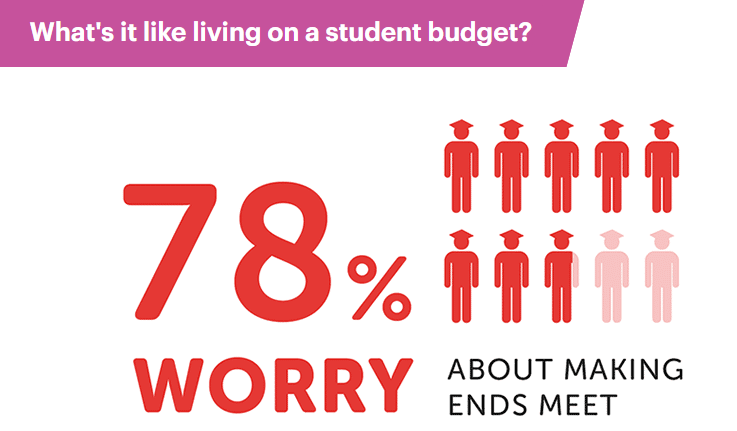
It is definitely not easy for a student to live on a tight budget. According to the National Student Money Survey 2018, 78% of students are stressed about not having enough money to get by. Hence, it is not shocking anymore to see students skipping meals, walking instead of taking public transport, missing class, working long hours in Sainsbury just to make ends meet; some even drop out of university because they really cannot afford the high tuition fees.
Hareef Okoye, a student from Nigeria said: “I am forced to dropout of university because I cannot afford to pay the tuition fees.”
University tuition fees keep increasing and University of Hertfordshire is one of them. According to University of Hertfordshire Fee and Finance Policy 2015/16, the undergraduate tuition fees for UK and EU students are £9,000 for 2014/15, and it increased to £9,250 for 2018/19. If you think this is a huge amount, think again. The international students have to pay £3,100 more per year than home students currently.
“The tuition fees are very much higher in the UK compared to my country, I only pay RM20,000 a year, which is equivalent to £4,000, and I’m paying £9,250 here,” said Chloe Narcis, a student from Malaysia.
Khushboo Sharma, a student from India said: “The tuition fees I’m paying doesn’t cover everything in my fashion course, I still have to fork out money for printing fees, cloths, fashion materials, and sewing machine.”
Many students resort to working part-time jobs to cover their tuition fees and other living expenses.
Okoye said that working part-time is not enough to cover the tuition fees despite skipping class to work for extra hours
National Student Money Survey 2019 found that 76% of students work part-time job to make extra money, which means it is very important for students to juggle work with study.
Accommodation
As time passes, the universities have grown more competitive in making the student life better by building more facilities and equipments, and this in turn brings up the accommodation fees.
University of Hertfordshire has built the Sports Village that allows students to be more involved in sports with this facility. However, the building, facilities, gym equipments and swimming pool has cost around £15 million. So, it comes as no surprise when students are required to pay around £100 yearly for the sport clubs membership fees, which is very expensive for the students.
Ryan Zhao, a student from China said: “Many of my friends wanted to join the gym membership but they didn’t because they cannot afford it.”
Adding on to the high accommodation fee, students have to fork out money for laundry too, where a one time ‘wash and dry’ cost £4.70, and that would be £18.80 per month.
“I don’t wash my clothes for up to a month because doing laundry is expensive”, said Sharma.
Zhao said, “I am already paying a very huge amount for my accommodation and I still have to pay for laundry, while living off campus provides unlimited usage of washing and drying machine.”
Many students choose to stay off-campus in their second year because it is less costly to stay outside campus. Besides, students get to choose where they want to stay and which price they are willing to pay depending on the condition of the accommodation.
“I am planning to stay off-campus for next year because it is much cheaper, in fact I have already found an accommodation that is £300 cheaper than what I am paying currently”, said Narcis.
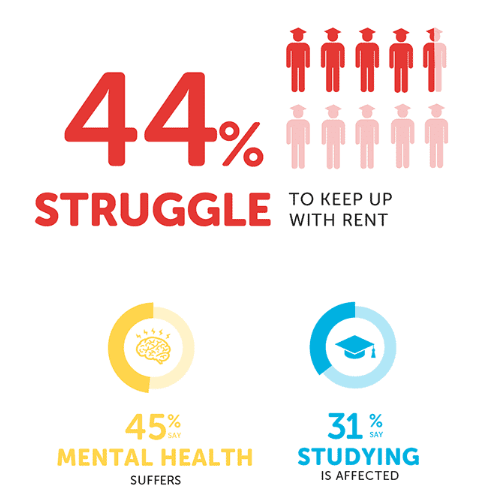
According to National Student Accomodation Survey 2018 on 2,246 students in the UK, 50% of the students rent from private landlords while only 20% get a place in university accommodation. The survey show that 44% of students find it hard to pay the monthly rent, 45% say the accommodation fees affect their mental health, while 31% cannot cope with their studies.
The National Student Money Survey 2018 also found that 50% of the students suffer dietically, where they cannot eat as much, as often or as healthily as they’d like. Students usually choose to cut down spending on groceries and daily meals to survive in their university life.
James McClatchey, a student from London said: “I cook to save money because buying groceries is a lot cheaper than eating a meal outside.”
McClatchey added that the price of an ingredient of a meal is equivalent to one fifth of the price for a meal in restaurants.
While some students cook simple meals at home or prepare lunches to class, others choose to starve themselves.
According to a survey conducted by George Charles of VoucherCodesPro.co.uk on more than 1,000 students, three in five students ignore the expiry dates, and 62% of these students judged the food by “look and smell” while 22% said they simply “hoped for the best”.
Carol Chan, a Singaporean student said: “Sometimes I only eat cereal for the whole week because I don’t have enough money.”
Students often choose to walk rather than taking the public transport, even though the bus does not seem to cost much but it can still help to save money in a long term. It is extremely normal to see students walking from the supermarkets back to their flats while holding bags of heavy groceries.
“Asda is 45 minutes walk from my flat but I would rather walk than take the bus even if it takes almost 2 hours, because every pound counts”, said Sharma.
It is obvious that students have to budget on their spending, especially those who do not work part-time. Therefore, students have to set priorities on where to spend money wisely.



 Documenting student living.